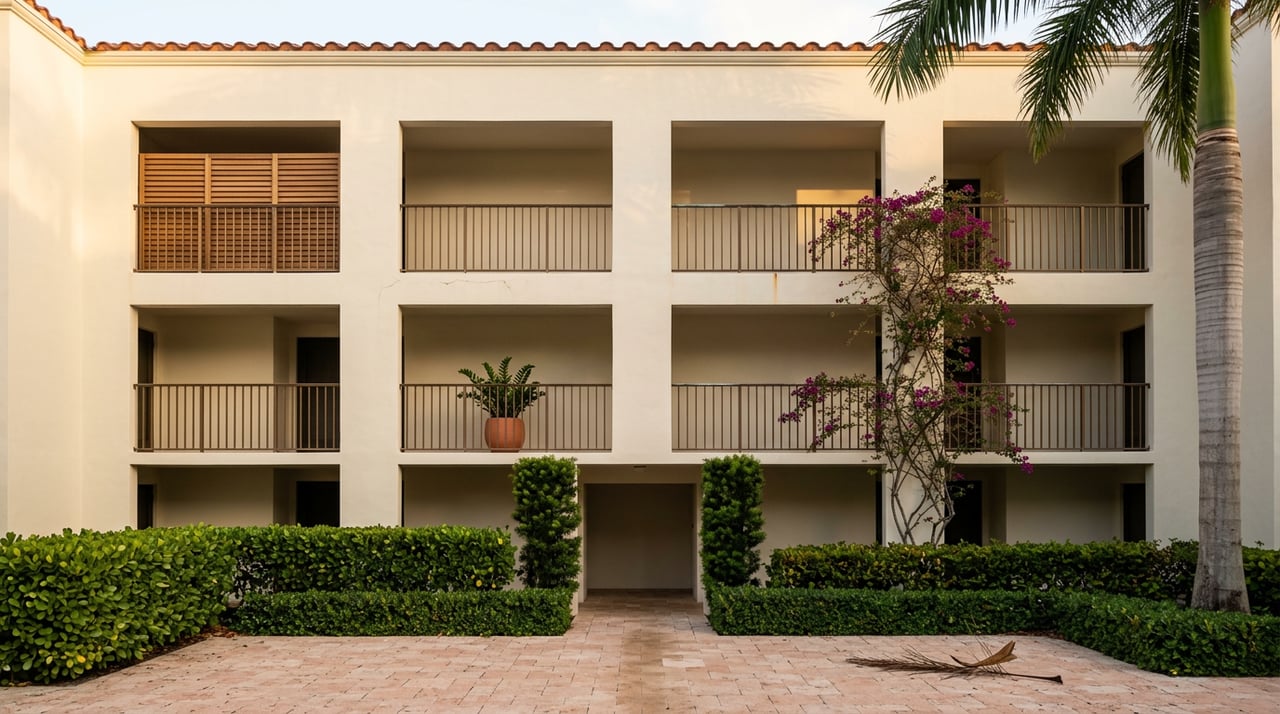
Two condominiums, half a mile apart on the island, list at the same price. Same square footage, similar finishes, comparable views of the water. One carries a monthly association fee of $1,400. The other asks $2,100. Every instinct built by a decade of house-hunting says the first one is the better deal.
In Palm Beach right now, that instinct is often wrong.
Since Florida closed the reserve-waiver loophole that let condo boards keep dues artificially low for decades, the monthly fee on a listing sheet has started to mean something different than it used to. A lower number no longer signals a better-run building. Increasingly, it signals a board that has not yet told its owners what the building actually needs.
The Fee That Used to Mean Nothing
For most of the past forty years, a Florida condo board could vote every year to waive or shrink its reserve contributions and keep dues comfortable. Roofs aged, concrete spalled, seawalls settled, and the money set aside to deal with any of it stayed thin, because thin reserves made for an easy annual meeting. Buyers rewarded that thinness by paying more for units with lower carrying costs, without asking what the low carrying cost was actually funding.
That option is gone for structural components. Under the state's Structural Integrity Reserve Study rules, any association budget adopted from 2025 forward can no longer vote to waive or underfund reserves tied to load-bearing walls, the roof, the foundation, waterproofing, electrical systems, plumbing, and the other big-ticket items covered by the study. Full funding was required to begin by January 1, 2026, which means the accounting fiction that kept a lot of Florida condo dues artificially low has, as of this year, run out of road.
What the Calendar Actually Forced
The law behind this took four years to fully land. Senate Bill 4-D passed in 2022 in direct response to the Champlain Towers South collapse in Surfside, creating two separate obligations for any condo or co-op building three stories or taller: a milestone structural inspection at 25 years for coastal buildings (30 years inland), and a Structural Integrity Reserve Study that prices out what the building's major systems will cost to maintain or replace. Senate Bill 154 refined the rules in 2023. House Bill 1021 added transparency requirements in 2024, including a mandate that associations with 25 or more units post their governing documents, budgets, and reserve studies online. House Bill 913 extended the original SIRS completion deadline into 2025 to give boards more runway.
That runway has now expired for most eligible buildings. Palm Beach County's own building division confirms the standing rule: coastal buildings get their first milestone inspection at 25 years of age, inland buildings at 30, and every ten years after that. For a board that has been quietly waiving reserves since the 1990s, the inspection and the reserve study tend to arrive in the same year, and they tend to arrive with a number attached.
When the Bill Comes Due
The numbers coming out of Palm Beach County over the past two years give some sense of scale. In North Palm Beach, a resident of the Governor's Pointe community described a reserve study that priced foundation, plumbing, electrical, and roof work at roughly $1.07 million, translating to about $30,000 per unit for owners who had budgeted for none of it.
"We want to feel confident, and you want to have peace of mind living any place."
That's how one owner facing the assessment put it to a local news crew, and the sentiment shows up again and again in county commission meetings: nobody disputes that the work needs doing. The dispute is over the fact that it was allowed to wait this long. On Singer Island, Dunes Towers launched a $45 million structural upgrade funded through assessments that averaged roughly $80,000 per unit, a project owners largely accepted rather than watch the building's value erode.
None of this is unique to any one building type. It is simply what happens when decades of deferred reserve funding meet a state law that no longer allows deferral.
Palm Beach's Own Vintage Stock
None of this makes an older Palm Beach building a building to avoid. Some of the town's most desirable addresses are genuinely old by any standard. The Palm Beach Biltmore opened as a boutique hotel in 1926 and converted to condominium ownership in 1970. The Warden House started as a private mansion in 1922 and became condos in the early 1980s. The Palm Beach Hotel Condominiums date to the mid-1920s. Casa 214 and Bienestar are smaller, boutique conversions with the same era of construction behind their charm.
Age on its own is not the risk. A well-run association that completed its milestone inspection years ago, funded its SIRS on schedule, and can produce clean financials is arguably a safer purchase than a newer building that has never been tested. The risk sits specifically in buildings where age and underfunding have quietly coexisted for years, because that combination is exactly what the current law was written to expose.
Same List Price, Two Very Different Buildings
| Building A | Building B | |
|---|---|---|
| Monthly fee | Higher | Lower |
| Milestone inspection | Completed, no major findings | Pending or recently flagged |
| SIRS funding level | Funded at or near 100% of study recommendation | Underfunded, catch-up plan in progress |
| Special assessment risk | Low, already priced into dues | High, likely still ahead |
| Financing outlook | Standard conventional lending | Possible lender restrictions if flagged |
Buyers who only compare the top row of this table are pricing the wrong risk. The fee is the symptom. The rows underneath it are the diagnosis.
Four Documents Worth More Than the Floor Plan
Before writing an offer on any Palm Beach condominium three stories or taller, ask for these directly rather than waiting for what the association is required to hand over at closing.
- The milestone inspection summary. This tells you whether a licensed engineer found substantial structural deterioration, and whether the building is in Phase 1 or already into the more serious Phase 2.
- The Structural Integrity Reserve Study, with the funding percentage. A study showing the roof at three years of remaining life and 15 percent funded is a specific, foreseeable assessment, not a hypothetical one.
- Two years of budgets and actual financials. Compare what the SIRS recommends against what the association has actually collected. A gap between the two is the clearest early warning available.
- The estoppel certificate. This is the document that confirms, in writing, any pending or approved assessment tied to the unit you're buying, and it is worth reading before the number becomes a surprise rather than a line item.
The Financing Trap Waiting at the Closing Table
There is a second-order effect worth understanding before you fall for a view. Buildings with lapsed inspections, thin reserves, or unresolved structural findings have increasingly been placed on secondary-market lender restriction lists, a practice that has expanded sharply since 2021 as Fannie Mae and Freddie Mac tightened condo project eligibility statewide. A unit that cannot qualify for conventional financing does not just complicate your own purchase. It shrinks your future buyer pool to cash buyers only, which tends to show up later as a discount on resale, whether or not the building itself is unsafe.
What This Means If You're Comparing Two Units Right Now
The comparison that matters this year is not finish level or floor plan. It is whether the building's paperwork is current, whether its reserves match what its own engineer says they should be, and whether the fee you're being quoted reflects the real cost of ownership or a number that has not yet caught up to reality. Reading a Structural Integrity Reserve Study accurately, and knowing which findings in a Phase 1 report tend to escalate into a Phase 2, is closer to reading a contract than reading a listing description. That is precisely the kind of document review Stephanie Schwed brings to a Palm Beach condominium purchase, drawing on a legal background and hands-on construction experience rather than a summary provided by the seller's side.
Frequently Asked Questions
Does any of this apply to single-family homes on the island? No. The milestone inspection and SIRS requirements apply specifically to condominium and cooperative buildings three habitable stories or taller. Single-family and duplex properties are exempt regardless of age.
How do I find out if a specific building has already completed its inspection? Palm Beach County's building division tracks compliance and can confirm whether a milestone inspection has been filed for a given address, and associations with 25 or more units are now required to post their inspection reports and reserve studies for owners to review.
Can a pending special assessment be addressed before closing rather than after? Sometimes. It depends on the timing of the board's vote and what the estoppel certificate discloses at the point of contract. This is a negotiation point worth raising early with your agent and attorney rather than discovering at the closing table.
If you are comparing Palm Beach condominiums and want a second set of eyes on the inspection reports, reserve studies, or financials before you write an offer, Let's Connect.