If the Jupiter Town Council approved the Suni Sands plan on Oct. 29, why did Mayor Jim Kuretski end the five-hour meeting by saying, according to Stet News, "We did not approve anything tonight"?
The 4-1 vote advanced four ordinances on first reading. It did not approve a building, a site plan or a marina. The council's real choice comes at the second reading. Under the January settlement, the public land on this parcel is tied to the private project. The town only gets the preserve if the development is approved, so the open question is how much the town will concede to get it.
A first reading, and a long list of conditions
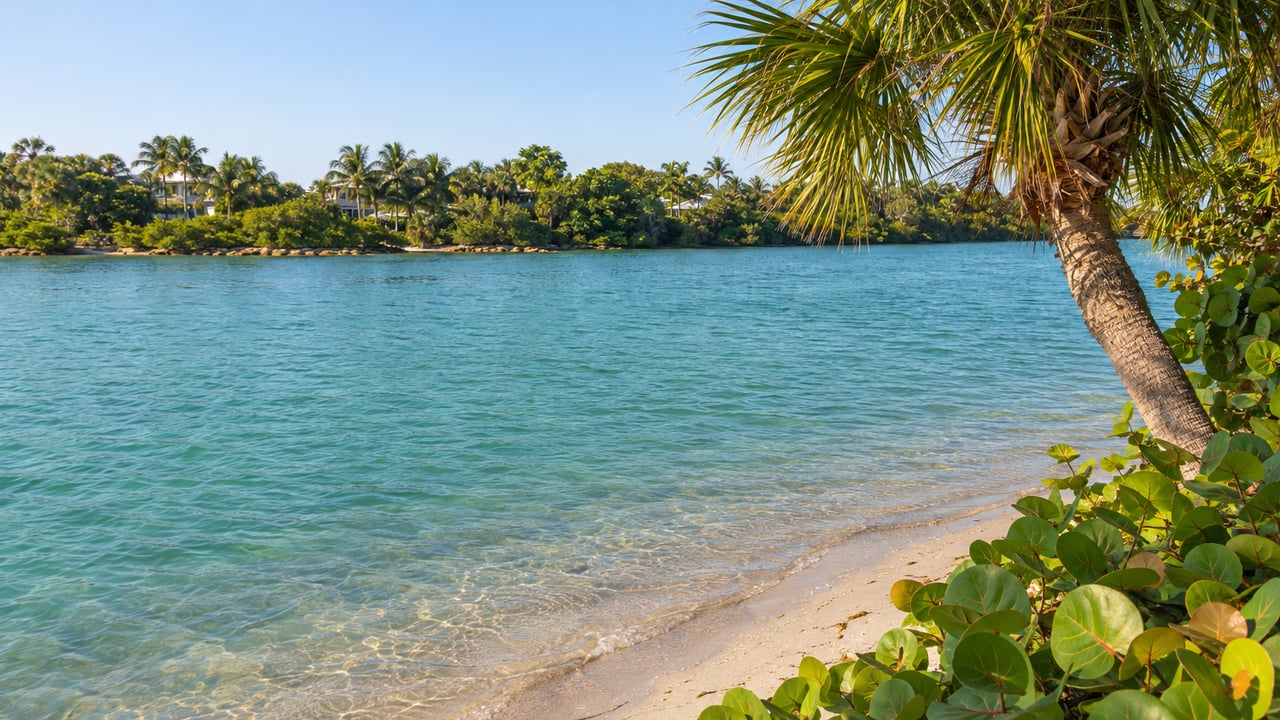
The parcel is the former Suni Sands mobile home park, about 10.5 acres at 961 and 997 N. A1A along the Loxahatchee River. It sits two blocks from Love Street, near UTiki and Square Grouper. CBS12 described it as one of the last undeveloped waterfront parcels near the Jupiter Inlet.
Developer Charles Modica, who built nearby Love Street with Joe Namath, proposes a 110-key hotel, 44 condominiums, a spa, a restaurant, shops and a 17-slip marina. At the special meeting, Jupiter Tide reported, Mayor Kuretski, Vice Mayor Phyllis Choy and Councilors Dan Guisinger and Malise Sundstrom voted yes on all four ordinances. Ron Delaney voted no each time.
The four ordinances are:
- Ordinance 30-26 redraws the Flex South subdistrict boundary in the Inlet Village zoning rules and changes its maximum building height.
- Ordinance 31-26 changes the land use map to about 5 acres of Inlet Village Flex and 5.5 acres of Conservation, and as written it shortens the Riverwalk corridor requirement.
- Ordinance 32-26 rezones the property into 5 acres of Flex South, 4.1 acres of Conservation Preservation and 1.4 acres of Conservation Restricted.
- Ordinance 33-26 creates the planned unit development, a quasi-judicial vote the council decides on the evidence presented.
The PUD passed with conditions. Before the second reading, the developer has to revise its Oct. 12 statement of use and either drop some waivers or offer more public benefits. The site plan is a separate decision that comes later. So does the marina, which is allowed in this district only as a special exception the council decides case by case.
The public half depends on the private half
The settlement explains why the council moved a plan its own planners had concerns about. On Jan. 20, after two years of negotiation, town attorneys and Modica reached a mediated agreement. Under it, the town takes ownership of the roughly 4-acre preserve parcel, which holds the shell midden and the route of the Celestial Railway, but only if the development is approved. The town also gets the right to buy a 1.4-acre view corridor at the northwest corner for $10.5 million to use as a passive park. Together those parcels come to 5.5 acres that cannot be developed.
Here is how the 10.5 acres would divide under the ordinances now before the council:
| Piece of the site | Acreage | Proposed zoning | What it holds |
|---|---|---|---|
| Development area | about 5.0 acres | Inlet Village Flex South | Hotel, condos, spa, restaurant, shops, marina access |
| Midden preserve | 4.1 acres | Conservation Preservation | Shell midden and Celestial Railway route, town-owned if the project is approved |
| Northwest view corridor | 1.4 acres | Conservation Restricted | Passive park the town has the right to buy for $10.5 million |
The midden is why the site was never treated as an ordinary waterfront lot. Stet News reported in January that 289 excavation tests between 2014 and 2022 turned up prehistoric ceramics and human remains, and the reporting links the midden to Jeaga and Jobe communities. The same settlement preserves a 950-foot strip marking where the Celestial Railway ran from 1889 until 1895. In Modica's plans, the old rail route runs through parts of the hotel, with tracks installed to show where the railway was.
The town has no cheaper way to get this land. At the meeting, Modica renewed his offer to sell the whole property to the town at fair market value, which he recently estimated at $130 million. The mayor said the town cannot afford to buy it. Modica paid $17 million for the former mobile home park in 2013. His attorney, Philippe Jeck, said that under the proposal, more than half the property would become public for the first time in 125 years.
The agreement also comes with a deadline. To fulfill it, the council has to approve a project by Dec. 31.
The Riverwalk figure is still open
Of everything the council voted on, the Riverwalk corridor is most likely to affect how residents use this stretch of A1A. As filed, Ordinance 31-26 cuts the required corridor across the site from 535 feet to 142 feet. Kuretski asked that the second-reading version say "less than 250" feet, which leaves the final number open. The remaining segment would move to the northwest corner, near the existing pier and the historic railway terminus.
The corridor figures before the council for the same stretch of shoreline are:
- 535 feet, the current corridor requirement, which the Planning and Zoning Commission recommended keeping in full
- Less than 250 feet, the mayor's requested language for second reading
- 142 feet, the figure in the ordinance as filed
The Planning and Zoning Commission went further than the corridor. It recommended 4.3 acres of Flex and 6.2 acres of Conservation, which would have kept a 0.7-acre shoreline strip in conservation. The filed ordinance does not include that recommendation. The council also asked staff to add a cap on traffic trips before the next vote.
Waivers are what the developer has to give up
Under a PUD, a developer can request exceptions to normal zoning in return for public benefits. Modica is requesting 14 waivers. They include:
- Modified floor-to-ceiling heights
- Reduced setbacks for a parking garage, pool, patio and deck
- A second story on the waterfront amenity building, which would house a snack bar and spa facilities
- Changes to parking rules, including tandem spaces
The amenity building waiver matters because of the zoning text near the water. Within 150 feet of the waterfront, buildings are limited to one story, or two stories with a PUD waiver approved by the council. The developer also wants to use the full 10.45 acres to calculate density, which would allow more housing units.
Council members said the benefits offered so far do not justify every waiver. Several said that anything already required by the January settlement or by town code should not count as an added public benefit. That rules out the midden preserve and the view corridor, because the settlement already provides for both. Whatever extra public benefit the developer offers will have to be something new.
Town planners also had concerns. According to Stet News, staff reported that the development is not consistent with Jupiter's comprehensive plan and that the proposed marina and docks would interfere with the view of the Jupiter Inlet Lighthouse. Nearly 40 people spoke against the project at the meeting and one resident spoke in favor. Delaney said he ran for office promising to preserve the waterfront. "I can't support any of this tonight," he said.
Modica described himself as a long-time resident who is frustrated by how long approval has taken. "I am at my personal extreme limits of what is economically plausible on this site," he told the council, according to Stet News.
What happens before Dec. 31
The order of the next steps comes from the ordinances, the PUD conditions and the settlement:
- The developer revises its statement of use and either drops waivers or adds public benefits.
- Staff rewrites Ordinance 31-26 with the "less than 250" feet Riverwalk language and a traffic-trip cap.
- All four ordinances come back for a second reading at a later hearing.
- The site plan and the marina's special exception are decided separately.
- Under the settlement, the council has to approve a project by Dec. 31.
Residents who want to follow or speak at the second reading can watch the Town of Jupiter's video of the Oct. 29 meeting and read the meeting agenda. Together they lay out each ordinance and the exact Riverwalk wording the council will vote on next.
The second reading will set how much of this shoreline stays open to the public, from the pier to the view toward the lighthouse. If you own near the Loxahatchee and want to talk through what the second reading could mean for your property, Stephanie Schwed is glad to help. Let's Connect.